
The use of technology to streamline how goods are stored, moved, and managed throughout a supply chain. It integrates systems such as robots, sensors, conveyor networks, autonomous vehicles, and inventory-tracking software to reduce manual work and improve efficiency. These technologies allow warehouses to sort items, track product locations, and coordinate shipments with speed and accuracy. Data from scanners, RFID tags, and sensors helps machines make real-time decisions about routing and inventory levels. Automated logistics supports industries like retail, manufacturing, and delivery services, enabling smoother operations and creating flexible systems that can adapt to changing demands.
Tech Kits
Beginner
Automation Technology with VEX Workcell
Length: 30 Minutes
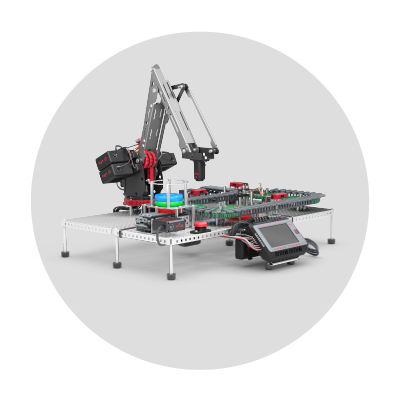
Description: Automation in logistics uses robotic systems like the VEX Workcell to handle tasks such as sorting, transporting, and organizing materials with precision and efficiency. These systems combine mechanical components, sensors, and software to create workflows that reduce manual effort and improve consistency, often applied in warehouses and manufacturing environments to streamline operations. The VEX Workcell itself is a robotic arm and conveyor belt system that can be programmed for different tasks, such as using a marker to draw a line based on a coordinate system, offering a simple yet clear example of how robotics integrates into practical applications.
Intermediate
Transporting Objects Using the V5 Optical Sensor
Length: 45 Minutes
Description: Automated logistics using the V5 Optical Sensor combines sensing technology with robotic control to manage objects based on color and movement. The sensor analyzes light patterns to distinguish items, while a robotic arm is programmed to pick up blue or red disks, hold them in front of the sensor, and place them into designated drop-off points depending on the detected color. This integration of sensors and automation demonstrates how emerging technologies apply simple physical principles and programming to create efficient systems for sorting and transporting goods in controlled environments.
Advanced
Conveyor System Automation
Length: 60 Minutes
Description: Conveyor system automation uses optical sensors and line tracker technology to improve how items move along industrial belts, detecting their presence and ensuring accurate flow for efficient operations. In practice, this is demonstrated through the VEX Workcell, which integrates all its systems and sensors to manage colored discs on a conveyor. The Workcell is programmed to identify red and green discs, discard the red ones, and use a robotic arm to pick up and move the green discs. Together, these sensing and automation tools show how emerging technologies streamline tasks and create reliable workflows in industrial settings.
Projects
Resources

VEX Workcell
Type: Hardware
Description: Alongside VEXcode software, this construction system creates a 5-axis robotic arm with conveyors and sensors.

VEXcode V5
Type: Software
Description:VEXcode V5 is the coding environment for programming the VEX V5 Robot.